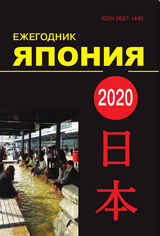
The Yearbook Japan is the core annual edition of Russian academic community specializing in the sphere Japanese studies. The decision to publish it was taken on February 26, 1971 at a meeting of the Japanese studies section of the Scientific Council for the Coordination of Research Works in Oriental Studies of the Presidium of the USSR Academy of Sciences. The publication of the yearbook, launched in 1972 by the initiative group of Soviet Japanologists, has not been interrupted ever since.
The concept of the yearbook assumes coverage of the widest range of scientific problems of Japanese studies, including issues of domestic and foreign policy of Japan, its economy and society, history, literature and linguistics, culture and religion. The Yearbook Japan contains articles rubricated in the sections of foreign and domestic politics, economics and society, history, and culture. The yearbook provides with analytical materials over the economic, political, social and cultural processes occurring in Japan.
Current issue
POLICY
The article presents an analysis of the history and current state of humanitarian contacts between Japan and India. The factors of religious and cultural community, as well as contacts between prominent philosophers and cultural figures due to the proximity of worldview concepts are studied. Special focus is placed upon the history of Indian independence fighters’ stay in Japan in the first half of the 20th century, as well as the position of India and its individual representatives on the issue of post-war settlement with Japan. The article examines how the common cultural and historical points are highlighted in the rhetoric of Japanese officials nowadays.
In particular, it is worth noting the two countries’ appeal to the ideas of BuddhistHindu unity as an attempt to unite Asian countries on this basis for cooperation on global issues. An analysis of the activities and rhetoric of Japanese prime ministers allows us to conclude that the greatest attention to the humanitarian aspects of bilateral relations was paid by S. Abe, who had a special sympathy for India. S. Abe was also known for his revisionist sentiments and desire to rid Japan of its post-war guilt complex, and attention to certain Indian figures, such as Subhas Chandra Bose and Radhabinod Pal, corresponded to the spirit of this policy.
The article also touches upon the peculiarities of cultural interaction between the two countries, in particular, popularization of Japanese pop culture and sports. Attention is given to education promotion, which is the key area of bilateral humanitarian cooperation today. Japan is currently emphasizing the promotion of Japanese language teaching in India, as well as programs in technical education and invitation of Indian specialists to Japan. A brief overview of the life of the Indian diaspora in Japan is carried out, which generally enjoys a favourable attitude of the locals. The combination of the efforts of the governments of both countries and the favourable ground formed as a result of religious and cultural proximity and the absence of negative experience associated with the Second World War create a solid foundation for strengthening mutual sympathy, which is reflected in the results of the survey of the population of the two countries.
The article is dedicated to the memory of Eisaku Sato, Prime Minister of Japan from 1964 to 1972, and was written in connection with the 50th anniversary of his death. The author attempted to address his personal contribution to the development of Japan and to analyze his political legacy from today’s perspective.
Sato belonged to the conservative mainstream (hoshu honryu) in the Liberal Democratic Party, which was associated with Shigeru Yoshida. Sato’s political ascent was characterized by his phenomenal ability to balance between the LDP factions, which were in extremely difficult and sometimes hostile relations with each other, and to maintain strong ties with the Japanese business community. His political career reached its peak by the end of the 1960s, when he almost singlehandedly controlled the entire top political establishment in Japan.
The author lists Sato’s achievements as head of the cabinet, including Japan’s rapid economic growth, promoted by active government regulation; strong social policy and a threefold increase in wages in the manufacturing sector; ambitious infrastructure projects, including the extension of the Shinkansen Line and the construction of Narita Airport; the holding of the international exhibition Expo 70 in Osaka. An important part of Sato’s political legacy, according to the author, was the practice of using advisory and other expert structures to prepare decisions bypassing traditional bureaucratic bodies. Many “strong” Japanese premiers later relied on the experience of Sato’s premiership. Among the most significant successes of Sato in the field of foreign policy and security, the article notes the return of Okinawa to Japanese administrative control on the terms of the withdrawal of nuclear weapons, as well as Japan’s non-nuclear policy, manifested in the Three Non-nuclear Principles proclaimed by Sato and the signing of the Treaty on the Non-Proliferation of Nuclear Weapons. For these achievements, Sato was awarded the Nobel Peace Prize in 1974.
ECONOMICS AND SOCIETY
One of the fundamental challenges in teaching history lies in the necessity for students to absorb a vast amount of factual information that is often disconnected from their personal experiences. To explore how this issue is addressed within the Japanese educational system, the study focuses on the 2018 high school curriculum reform. This reform merged Japanese History and World History into a single compulsory subject, “General History,” fundamentally transforming the structure of high school history education that had been in place since 1989. The current study aims to identify the trends in Japan’s education policy that underlie this reform. Based on the analysis of policy documents, expert commentaries, educational standards, and textbooks, the study outlines the methodological and curricular features of the reform, as well as its continuity with previous policy initiatives. The findings suggest a consistent policy trajectory focused on increasing interactivity and global perspectives in education. The paper also highlights both the potential benefits and risks of the reform in addressing pressing issues of Japanese history education.
HISTORY
In October 2024, the authors personally participated in the work of an international expedition to Takashima Island in Nagasaki Prefecture in Japan to study the Takashima-3 underwater site, associated with the Mongol invasion of 1281. This article presents an overview of the main results of long-term research in Imari Bay, where sunken ships are buried. The review is accompanied by a brief excursion into the history of the 13th century Mongol invasions. To date, the remains of three ships have been found, the finds from which confirm the hypothesis that the remains of the ships belong to the naval flotilla of the Mongol Yuan Dynasty (1271–1368).
The main finds from the sunken ships include iron helmets, fragments of quivers with arrows, anchors, stone cannonballs, Chinese and Korean ceramics and porcelain, bronze Buddhist statues and mirrors, and everyday utensils. The archaeological finds from Takashima Island represent an important source of information about the naval history of the region, the technological level of shipbuilding, and the dynamic interaction of the peoples of East Asia in the early 2nd millennium.
This chapter uses a new visual source – a series of advertising cards “History of Japan” for meat extract from the Liebig Company, released in 1938 in Switzerland. The company was founded by German chemist Justus von Liebig, whose achievements primarily were related to organic chemistry, new technologies in the field of nutrition, and popularization of chemistry in general. The products were advertised using cards that introduced the customer to life in different countries of the world. This study focuses on a series of 12 cards dedicated to different milestones in the political history of Japan. In addition to the visual material, the accompanying texts on the back of each card are of particular interest: they reflect not only the undying interest of Europeans in Japan, but also the special rhetoric that recognized the victory of the Japanese Imperial Army in China and Korea. This chapter is a brief study and a full translation of all 12 cards from French. The material of the research is intended primarily for historians studying different periods of Japanese history, its ideology and politics, philocartists and art historians, as well as for the general readership.
The article examines how the Japanese authorities tried to introduce Russian emigration to Japanese culture. For this purpose, the 2600th anniversary of the founding of the Japanese Empire is studied. Both printed materials (newspapers, magazines, books), and compulsory participation in ceremonies were used. Such Russian emigrant newspapers as Golos Emigrantov (“Emigrants’ Voice”) and Zarya (“Dawn”), and the Luch Azii (“Ray of Asia”) magazine actively published materials that introduced Russian emigrants to the history, culture, and modern achievements of Japan.
These publications promoted the mythological history of the rise of the Japanese Empire, which was now bringing light and enlightenment to all peoples in East Asia. Using the anniversary date, the Japanese authorities and their allies among the Russian emigrant elite (the leadership of the Bureau for Russian Emigrants in Manchuria) tried to bring the Russian emigration even closer to the ideas of loyalty and cooperation with the Japanese authorities.
Celebrations dedicated to the foundation of the empire were conducted all over Manchuria, where Russian emigrants lived. The leadership of the Russian emigration, represented by representatives of the Bureau of Emigrants in Manchuria, was allowed to attend the celebrations in Japan in February 1940. In addition, a delegation of representatives of the Russian emigrant press was sent to Japan in the fall of the same year, tasked with describing the achievements of the Land of the Rising Sun, which was done after their return to Manchuria.
The article continues to analyze the little-studied aspects of Japanese-French relations during the Second World War – the collaboration of the French state (Vichy regime) and the authorities of French Indochina with Japan and their resistance to the Japanese military, political, economic, and propaganda expansion. The strategic goal of Japan after the military defeat of France in 1940 was to establish control over Indochina, so as to include it into the “Great East Asia CoProsperity Sphere.” The Vichy regime proclaimed a policy of “preserving the empire,” but had to compromise with Japan because of the inequality of forces in the region and its remoteness, and then, from late 1941, the complete isolation of Indochina from the homeland.
The actions of the Indochina authorities were usually considered in isolation from the policy of the French state as a whole, therefore, the article pays special attention to the policy making process and its authors, as well as the analysis of the concepts of “collaboration” and “resistance,” which, in this case, have a specific meaning. The work is based on documents, diaries, memoirs, and other evidence from the actors in combination with the latest historical research.
CULTURE
From the 1620s until the last quarter of the 19th century, most books published in Japan were woodblock printed. In comparison to modern books, woodblock books had a number of specific features. Books were almost always bound in the same way, which is called fukurotoji (sheets printed only on one side were folded in half, collected in a pile, and sewn to the cover, which was also a sheet of thick paper). Variations of symbols could be used for the same kana character, but the reading of the kanji characters was often spelled out. The title of the book was usually indicated on a small narrow sheet of paper glued to the cover. Of particular importance for a woodblock printed book is calligraphy in which the main text, preface, afterword, and other elements are written. Many authors created not just a text, but a book, and were book designers. One of such designers was Ozaki Masayoshi (1755–1827), the author of the work Hyakunin Isshu Hitoyogatari (Evening Stories About “One Hundred Poems by One Hundred Poets”), published in Ōsaka in 1833.
Since the author was a famous calligrapher, the creators of the book, who published the work after the author’s death, preserved his ideas regarding the design and were guided by his handwriting. A well-known artist Ōishi Matora (1792–1833) took part in the creation of the book, and the publishing house commissioned famous intellectuals to write a preface, afterword, and epigraph for the book. The article examines the construction of the book, the way the main text is presented, the elements surrounding the main text, i.e., what, according to literary scholar Gérard Genette, enables a text to become a book. In the context of general information about woodblock printing of the Tokugawa period, the features of the book Hyakunin Isshu Hitoyogatari are considered: printed sheet, binding, method of writing the text, illustrations, preface, table of contents, epigraph, afterword, colophon.
The history of Japanese-Dutch relations began in 1600, when a ship called De Liefde reached the shores of Japan. In 1609, after an audience with the founder of the Tokugawa dynasty, Shogun Tokugawa Ieyasu, the Dutch managed to obtain an official document according to which the ships of the Dutch East India Company could henceforth sail to Japan. In the Edo era, during the period of self-isolation, Holland remained the only Western country with which Japan maintained trade relations. Dutch merchants lived on the tiny artificial island of Dejima in Nagasaki Bay. At first, trade was going well, but, as early as in 1743, the trade mission in Dejima suffered its first loss.
The power of Great Britain and the United States grew, while Holland, on the contrary, lost its influence. However, the gradual deterioration in the field of trade coincided strikingly with the increase in the influence that Holland had on Japanese culture, life, and language. In the Edo period, Holland became a kind of a “window to Europe” for Japan. There is an opinion that, if Holland’s influence on Japan had been weaker during this period, the modernization process in Japan at the beginning of the Meiji era would have been much more difficult.
The great Japanese educator of the Meiji period Fukuzawa Yukichi (1835– 1901) managed to visit Holland as part of the Takenouchi mission (1862). It is likely that, when writing the chapters about Holland in his geographical works “All the Countries of the World” (1869) and “The State of Affairs in the West” (1866–1869), he relied, among other things, on his own experience of getting to know this country. Fukuzawa classified Holland as a developed and enlightened country. However, in his opinion, Japan should keep up with the times and focus on more advanced countries, such as the United States and Great Britain.
Toshihiko Izutsu (1914–1993) was an eminent Japanese scholar of Islamic studies whose academic legacy in the field encompasses Qur’anic studies, philosophy, theology, Sufism, history, and cultural studies. The article traces his intellectual trajectory from studying Arabic to his emergence as a worldclass Islamicist. Its primary focus is the core of his scholarly contribution – his methodological innovations in Qur’anic semantics. Central to this examination is the original semantic method developed by Izutsu, grounded in the works of Western linguists (W. von Humboldt, B. L. Whorf, J. L. Weisgerber, E. Sapir). Professor Izutsu proposed novel perspectives for analyzing the Qur’an through the study and immersion into its “linguistic worldview” (Weltanschauung). The work provides a detailed analysis of Izutsu’s method as expounded in his seminal works God and Man in the Koran (1964) and Ethico-Religious Concepts in the Qur’an (1966, new edition 2002), encompassing the analysis of dynamic “semantic fields” within Qur’anic vocabulary (e.g., kufr, islām, īmān) in their pre-Islamic context and their evolution during the Revelation; the investigation of the historical transformation of key ethicо-religious terms’ meanings; and the study of the intrinsic connection between linguistic structures and the formation of the unique religious worldview of Qur’an. Criticism of Izutsu’s methodology is also presented, including positive critique from Abd al-Rahman Hilali and Samir Rashwani (University of Aleppo), alongside negative critique from Seyyed Hamidreza Mirazimi (School of Islam and Islamic Thought, University of Tehran), Afrasiyab Salehi, and Mohalad Naji Kamil (University of Thi-Qar, Iraq). The study concludes with examples of the contemporary application of Izutsu’s method to the analysis of the Qur’anic terms istiwā and saff.
The popularity of haiku and its composition by authors in the Russian language, as well as reflection on the definition of boundaries and formal criteria for belonging to this category of texts formed the frame for poetry of “haiku masters,” or haijin, who adhered to the strict canons of the original tradition, and poets who applied it for the purpose of creative experimentation, or allowed its free interpretation. At the turn of the 20th and 21st centuries, the first printed platform that provided space for haiku written in any of these keys was the almanac Triton, the publication of which continued over four issues. This feature makes it a representative source for the analysis of the perception of haiku by Russian-speaking authors.
This paper focuses on those poets published on its pages who allowed the possibility of free interpretation of the poetic tradition of haiku, its domestication, or use for other purposes of creative transformation. In addition to the original haiku, the works included by the almanac’s compilers in the section called “At Haiku’s Neighborhood” are also considered, in which Russian-language threeline poems are inscribed in the context of haibun and uta-monogatari. The paper analyzes the features of these works and their relationship to the original tradition.
The article analyses relations between the religious ethics of the new Japanese religion Seichō-no Ie and contemporary principles of the Green Agenda, including the concept of sustainable development. The study is based on a comparison of key doctrinal statements of Seichō-no Ie with the normative framework of Japan’s environmental policy, in particular the implementation of the Sustainable Development Goals (SDGs), the Green Transformation (GX) strategy, and a number of national greening and decarbonization initiatives. It is shown that the Seichō-no Ie movement offers an original form of environmental ethics, embedding sustainability in the structure of religious thinking and the concept of karma, and, therefore, not only resonates with the official “green agenda,” but also deepens its spiritual and moral content.
Particular attention is paid to the criticism of industrial lifestyles, fossil energy, and nuclear power plants, which, in the teachings of Seichō-no Ie, are seen as a form of bad individual and collective karma. These views are underpinned by a notion linking the pollution of nature to spiritual degradation. It is based on a divine revelation by the founder of the religion, Taniguchi Masaharu, entitled “Divine Messages on the Lighter of the Seven Golden Candlesticks.” There, one can find the phrase “Be grateful to everything in the Universe!,” which has become the doctrinal rationale for supporting the environmental cause.
The article elaborates on spiritual practices, architectural initiatives (“Office in the Forest”), and the promotion of vegetarianism as an ethical and environmental norm, which contribute to the formation of a specific environmental religiosity. It is emphasized that the concept of intergenerational justice in the teachings of Taniguchi Masanobu is given a special religious depth by the doctrine of rebirths, according to which a person who harms the environment potentially condemns themselves to suffering in a future life.
On the basis of field research and texts of the doctrine, it is shown that Seichō‑no Ie can be interpreted as a form of deep environmentalism, in regards with E. Dobson’s green theory, in which the value of nature and the need to protect it have not utilitarian but ontological and ethical grounds. The article contributes to the understanding of the role of religion in expanding the horizons of environmental thought.
The article is written on the occasion of the 80th anniversary of a famous Japanese actress and public figure Kurihara Komaki, a knight of the Russian Order of Friendship of the Peoples, who, for more than 50 years, has contributed greatly to the movement for friendship and development of cultural ties between Russia and Japan. Her participation in such co-production films as Moscow, My Love, Melodies of the White Night, Crew, Step, and others, as well as in a large number of performances based on Russian classics, in which Kurihara acted as director and performer of the main roles, brought her great fame in her homeland and in our country. In recent years, she has chaired the organizing committee of the Russian Culture Festival in Japan, which, in the context of a sharp deterioration of political relations between our countries and the blockade of Russian culture in the world, remains an effective channel for maintaining bilateral public contacts and finding ways to normalize inter-state cooperation.
TRANSLATIONS
In the second scroll of his Treatise on Ten Stages of Mind of Secret Mandala, a Buddhist philosophy compendium, Kukai discusses the lowest level of spiritual progress highlighting the absence of right seeing and inclination towards the wholesome among the beings of this stage as the dominating trait of their mind. The scroll is largely concerned with the cosmological issues including the various classes of living beings whose way of life is based on unwholesome courses of action, as a result of which the sense of suffering is particularly heightened.
The article examines a valuable source on the history of the Sengoku and early Edo periods, Mikawa Monogatari 三河物語 (The Tale of Mikawa), written by samurai Ōkubo Tadataka. Ōkubo, a family of hereditary vassals of Tokugawa (Matsudaira) house, played an important role in the rise of this house, whose original holdings were located in the western part of Mikawa Province. Tadataka, under the command of his brother Tadayo, participated in many military campaigns and battles, was acquainted with the Tokugawa warlords and Tokugawa Ieyasu himself.
The sources for Mikawa Monogatari were both the memoirs of Tadataka, who was an eyewitness to many of the events described in his work, and stories he heard from relatives and other vassals of the Tokugawa clan. In addition, he also turned to various written sources. The surviving three-book autograph represents the final version of Mikawa Monogatari, while most of the copies appear to reproduce the original, unfinished version of the text. Although the colophons in three books date the autograph to the 8th year of Genna (1622), in reality, the manuscript was probably completed later, between 1626 and 1632. Apparently, Tadataka began writing his work after 1615 and had prepared the first versions by 1622.
The Mikawa Monogatari recounts the history of the Tokugawa dynasty, glorifies the exploits of Tokugawa Ieyasu, and recounts the exploits of the Ōkubo clan’s descendants in the service of the Tokugawa. Tadataka intended his work to serve both a commemorative and a didactic function. In Mikawa Monogatari, its creator saw a means of maintaining proper ties between his descendants and the overlords of the Tokugawa house, he called on his children not to stop their faithful service under any circumstances. It can also be noted that Ōkubo Tadataka also addressed his work not only to his relatives, but also to samurai from other clans. This publication also includes a translation into Russian of a fragment of the book II of Mikawa Monogatari, which primarily tells of the wars of Tokugawa Ieyasu with daimyo Imagawa Ujizane, as well as of Ieyasu’s participation in the military campaigns of Oda Nobunaga.
SCHOLARLY DEBUT
The article is devoted to revealing the mechanisms of depicting the process of identity transformation in the literary work of the Japanese diaspora in Brazil. The aim is achieved by studying small prose in the genre of naturalism using the material of the Collection of Colonia Stories. The time frame is limited by the arrival of immigrants in 1908 and the prohibition of foreign language printing in 1941.
The article describes the formation of the collective identity of the Japanese in Brazil from a historical perspective. The key features of the Japanese emigration, further reflected in the literary work of the diaspora in Brazil, are revealed: regional localization, migrants’ belonging to the peasantry, the formation of a special koroniago dialect. Special attention is paid to the reasons for the split within the diaspora, which became the main motif in the problems of literary works. Intragroup disunity has its roots in the social structure of the Japanese community and was stimulated by the urbanization of the 1930s.
The article analyzes the process of formation of a distinctive center of literary creativity in the Japanese emigration in Brazil. The mechanisms of alienation of literary works based on the opposition between “pure” and “mass” literature are revealed.
The transformation of Japanese identity in Brazil is evidenced by analyzing the problematics of the works. The painful process of integration into the host community gives center stage to the racial-ethnic issues of imin bungaku. The works depict the interaction between Japanese and Brazilians through inter-ethnic conflicts. The works studied reflect discursive patterns of describing the racial Other in the space of literature. The works are particularly sensitive to the betrayal of intra-community bonds and the acquisition of the traits of the host community. The process of identity transformation is examined in literature through the prism of social status, ethnicity, and gender discrimination. The analysis of the works shows the evolution of the representation of the Other from demonization and rejection to acceptance of the transformed identity. The change of perspective on the formation of a bicultural “Japanese-Brazilian” identity on the eve of World War II was interrupted by the outburst of Japanese nationalism during the war years. However, the acceptance of one’s own otherness and the literary representation of this process would become the foundation for the successful integration of the Japanese into Brazilian society in the postwar decades.
BOOK REVIEW
In 2022, the Toshindo Publishing House published a book by a famous Japanese scholar, Honorary Professor of Tokyo University of Foreign Languages Okada Susumu. The book covers a huge historical period, during which the Soviet and later Russian society and the country’s economy went through a series of dramatic transformations, which have no analogues in human history. Being a high-class professional, Professor Okada identified the most important events and problems in the hundred years of Russian history, demonstrating a deep understanding of their essence. Professor Okada used a problem-historical approach to analyze the changes in the Russian economy and society over the course of a century. The book consists of three sections. The first section, “Two Systemic Upheavals,” analyzes the features of Russia’s economic development from the October Revolution to the collapse of the Soviet Union and the beginning of the formation of a new Russia. The second section, “Changes in the Economic System and the Situation of Workers,” examines a wide range of issues characterizing the situation in various spheres of society in the Soviet Union and post-Soviet Russia. Finally, the third section, “Soviet Socialism and Russian Capitalism,” contains an analysis of the essence of both Soviet socialism and modern Russian capitalism. Each chapter is provided with an extensive list of literature (mostly in Russian), from academic works to periodicals. Interesting details are woven into the rigorous academic analysis, which indicates the author’s excellent knowledge of Russian realities, not only of the Soviet and post-Soviet periods, but also of earlier times. Unfortunately, it is impossible to reflect all the advantages of Professor Okada’s book in a short review, but there is no doubt that it makes an important contribution to the study of our country and the vicissitudes of its development in Japan.
In 2025, an unusual work was published by Saint Petersburg gallery KASUGAI with the assistance of the “Yellow Yard” bookstore. The KASUGAI gallery has existed for over 20 years and exhibits Japanese art. This article is a review of the album Parting With Life: Tales of the Faithful Vassals From Ako in Illustrations by Ichiyusai Kuniyoshi (2025).
The idea of publishing the album arose after the gallery’s collection acquired an original 19th century Japanese album of prints by a famous artist of the late Edo period (1600–1868) Utagawa Kuniyoshi (1798–1861). The album included prints from the series “Stories of the True Loyalty of the Faithful Samurai” and “Stories of the True Loyalty of the Faithful Hearts,” dedicated to the story of the 47 rōnin, one of the most popular stories about Japanese warriors. These prints, translated and provided with comments, were published in this album. The prints are given a detailed explanation. Thanks to that, even a reader studying Japanese prints for the first time can explore them.
The story of the rōnin from Akō of 1701–1703 is a prime example of a romanticized legend of samurai devotion, reaching fanaticism. It is also a classic story of revenge. It won the love of people far beyond Japan, influencing the formation of the modern image of the Japanese warrior class.
The translation of the cursive texts of “Stories of the True Loyalty of the Faithful Hearts” into Russian is given in this album for the first time, which makes it the most convenient and accessible way to get acquainted with the beautiful prints of Utagawa Kuniyoshi from two collections at once. In addition to the prints, the album includes unique materials: three introductory diptychs and a sheet with a description of the relics of the rōnin.
Furthermore, the pictorial and source part was supplemented by completely original academic articles, significantly enhancing immersion in the context of the legend of the 47 rōnin. The authors of the articles are leading Japanologists Trubnikova N. N., Shchepkin V. V., Guseva A. V., Sinitsyn A. Yu., Melnikova I. V., Khomchenkova V. V., Golda A. I., Tyagunova E. O., Kubasov F. V.
ACADEMIC LIFE

ISSN 2687-1440 (Online)